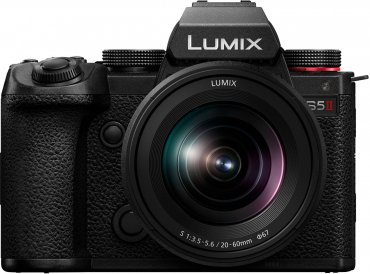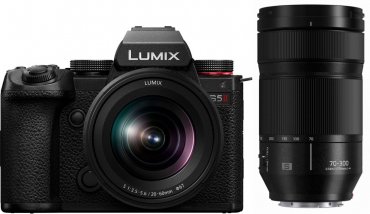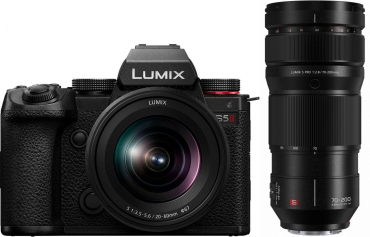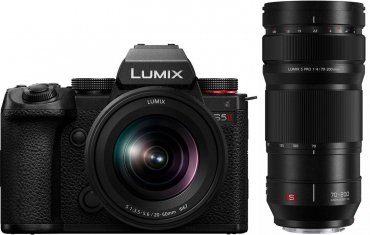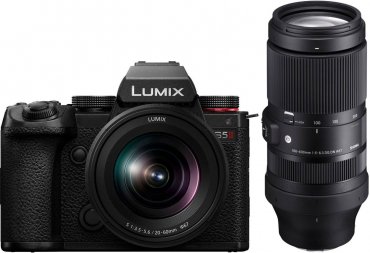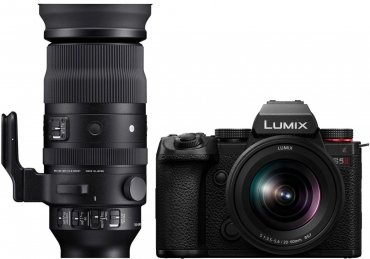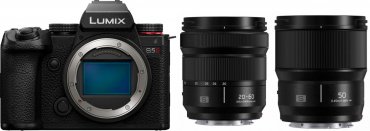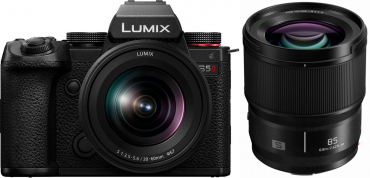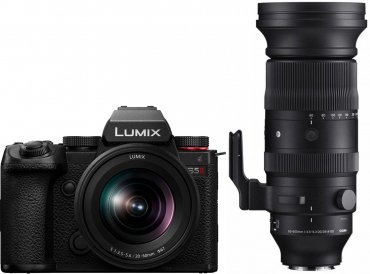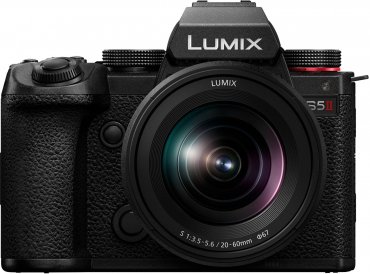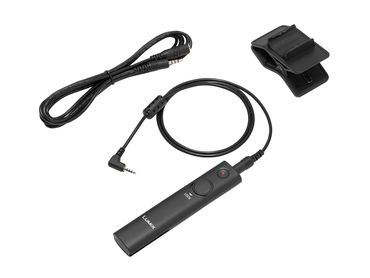
Panasonic DC-S5 II Body
With its outstanding photo and video performance and an amazingly compact and robust body, the LUMIX DC-S5M2 meets the high demands of creative photo and video enthusiasts while offering exceptional value for money.

The S5M2 is based on a newly developed 24 megapixel full-frame CMOS sensor and an equally new image processor, which was developed as part of the L² technology partnership between LEICA and LUMIX. For the first time, the sensor in the LUMIX system supports phase detection in addition to contrast-based autofocus and combines both focusing methods to create a new hybrid phase detection AF. In addition, the new processor offers outstanding image quality and video performance with high bit rate or 6K resolution.
- Uncompromising image quality
- Strong support for mobile use
- Highest photo and video performance
- Outstanding user-friendliness
- New processor with L² technology
- New phase hybrid AF
- Strong further development of the autofocus
- New Active I.S. image stabilization
- New 24.2MP CMOS sensor with phase AF
- New REAL TIME LUT - color corrections can be made with the camera itself
- Intuitive control when looking through the viewfinder - joystick with 8 directions
- Sophisticated menu design
- Unconditional focusing on the subject - OLED LVF & 180° LCD
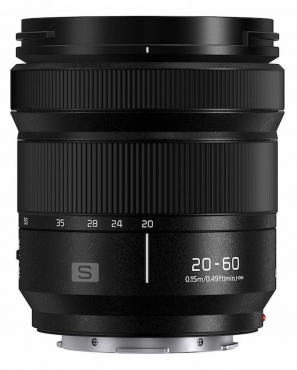
Panasonic LUMIX S 20-60mm F3.5-5.6
The LUMIX S 20-60mm F3.5-5.6 is a robust, lightweight standard Zoom lens with a focal length from 20mm ultra-wide angle to 60mm for versatile use from dynamic landscape shots to portraits. The wide angle of view also facilitates indoor shooting and the impressive close-up limit of 0.15 m (maximum magnification 0.43x) extends its use in product photography. The LUMIX S Zoom also ensures high-quality video recording by minimizing focus breathing in the best possible way.
Thanks to its compact design and low weight of around 350 g, it does not compromise the photographer's mobility. It is characterized by a dust- and splash-resistant design* and can be used in the most adverse conditions down to -10°C. In addition, a fluorine coating on the front element repels water and oil. The filter diameter is 67 mm and the lens has nine blades for a virtually circular aperture.
The lens consists of 11 elements in 9 groups and uses 2 aspherical lenses and 3 ED (Extra-low Dispersion) lenses to suppress both axial chromatic aberration and chromatic magnification difference. Astigmatism can also be corrected with these aspherical lenses, resulting in high resolution performance. Furthermore, the UHR (Ultra-High Refractive Index) lens enables uniform image quality from the center to the edges of the image and ensures a compact design.
Panasonic Lumix S 24mm f1.8
The Panasonic Lumix S 24mm f1.8 impresses with its high imaging performance and its 9-blade circular aperture provides a particularly attractive bokeh. In addition, the lens offers outstanding portability thanks to its compact size and light weight. It also features a dust- and splash-resistant design and can be used in the harshest conditions down to -10° C. As part of the F1.8 lens series, it shares the same size and position of the controls, as well as the same 67mm filter diameter, for intuitive and consistent handling. Finally, it also ensures high-quality video by suppressing focus breathing.
Sophisticated lens design for best image quality
The LUMIX S 24mm F1.8 lens consists of twelve lens elements in eleven groups, including three aspherical lenses, three extra-low dispersion (ED) lenses, and one ultra-extra-low dispersion (UED) lens. The use of three aspherical lenses and nine circular aperture blades enables both high imaging performance and an attractive bokeh effect with smooth sharpness-blur transitions. The ED lenses and UED lens effectively suppress chromatic aberration.
Finally, in the joint development of the F1.8 lenses, emphasis was placed on uniform image appearance as a further quality feature.
Particularly fine eye when focusing
The LUMIX S 24mm F1.8 operates quickly and silently with the camera's high-precision contrast AF system at a maximum of 240 fps. When using manual focus, a non-linear or linear setting can be selected for the focus ring. In the non-linear setting, the focus is shifted by a variable amount according to the rotation speed of the focus ring, e.g. to switch more quickly between focus areas. Whereas in the linear setting, the sharpness is always shifted linearly according to the angle of rotation of the focus ring. The entire focus range can be traversed in 90 to 360 degrees (adjustable in 30 degree increments) in the linear setting.
Simply subscribe and receive weekly updates and offers on photography and video equipment.